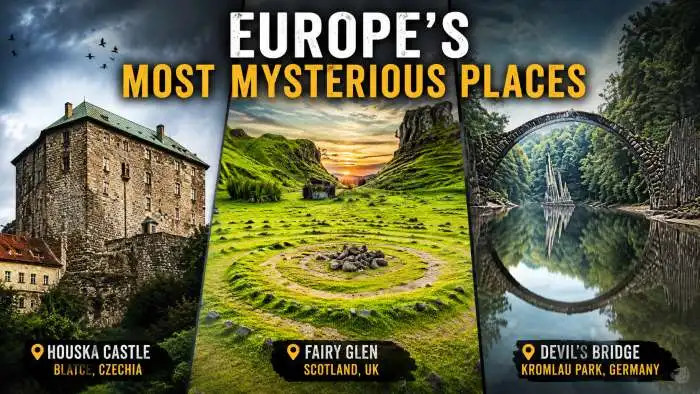
Our planet crams so many incredible locations that you simply can’t believe are actually real – or simply protects them with tales that cannot be rationalized. It goes without saying Europe offers no end of each. From Devil-shaped rocks to terrifying castles that you may make certain provide you with goosebumps, we cannot explain exactly why each of them is still right here.
Houska Castle, Blatce, Czechia
What looks like this perfectly harmless – and, frankly, beautiful – castle could also be the door to hell, according to the locals. Located in Blatce, Czechia, the castle dates back to the 13th century. Currently, it’s also considered one of the most haunted spots on earth. Local lore suggests that builders constructed Houska Castle on top of a pit so deep, its depths could not be plumbed. At night, it is said that creatures of darkness ascend from the hole, pulling any unwary traveler down with them.
You may also read :- Mysterious Places in the World No One Can Explain
Crooked Forest, Gryfino, Poland
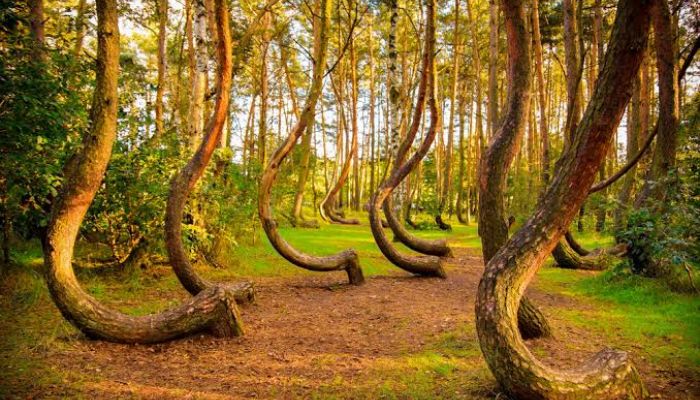
About Crooked Forest You’ll see this aptly nicknamed area located just outside the Polish city of Szczecin. Crooked Forest features some more than 400 of the world's most peculiar looking pine trees. Every tree features a sharply bent trunk. Arboriculturists have discussed for decades why these peculiar trees look like this, and to this day nobody can explain why. However, some believe local lumberjacks introduced a new method of cultivation, while others guess intense snowstorms bent them.
Blue Grotto, Capri, Italy
Just off the island of Capri, a sea cave beyond anything else exists. Locals blame the spectacular blue glow of the grotto, called the grotto of, on monstrous, evil sea-spirits. These spirits used to terrorize the villagers of Capri so much that they would avoid entering this magical spot at all costs. Today, science proves how this is possible. Behind the entrance, a shallow hole allows sunlight to shine through and naturally create a blue color.
Fairy Glen, Scotland, UK
The remote, fairy-ridden site, where the film Stardust was shot, has associations with magical beings for hundreds of years, with many believing it was shaped by magical powers. Visitors have claimed to feel as though they are being observed by mythical creatures, but the formations are actually the result of a landslip – the castle-like spires formed from toppled rocks. Tourists have recently begun stacking stones to form spirals within the glen.
Bran Castle, Transylvania, Romania
While Dracula is perhaps the main draw at the castle, it's not the only factor contributing to the allure of Bran Castle, which is almost always veiled by a ghostly morning mist. According to local lore, local legends claim that Dracula's medieval castle served as the former prison of the 15th-century impaler Vlad the Impaler. Local superstitions also say that troubled spirits (known as strigoi) come back from the dead each night to feed on blood.
Devil’s Bridge, Kromlau Park, Germany
So why would such a pretty place carry such a fearsome name? As it happens this German monument (in Kromlauer Park, Saxony) is actually thought to have been built by the Devil himself. Apparently local lore dictates that the German structure is so precisely semi-circular it could only have been conjured by super-natural means.
The soul of the first person to venture across was taken by the Devil (ouch!). Sadly, this pretty bridge cannot be walked upon today.
Giant's Causeway, County Antrim, Northern Ireland, UK
On the coast of County Antrim stands Northern Ireland's natural gem, Giant's Causeway. The site, measuring 173 acres, hosts some 40,000 interlinked columns of basalt that gradually slope towards the sea. Trace the dramatic formations over the sea, and they lead you to the Scottish Isle of Staffa where a near identical view awaits, almost as though two lands are united.
Pindus Mountain and Vikos Gorge, Greece
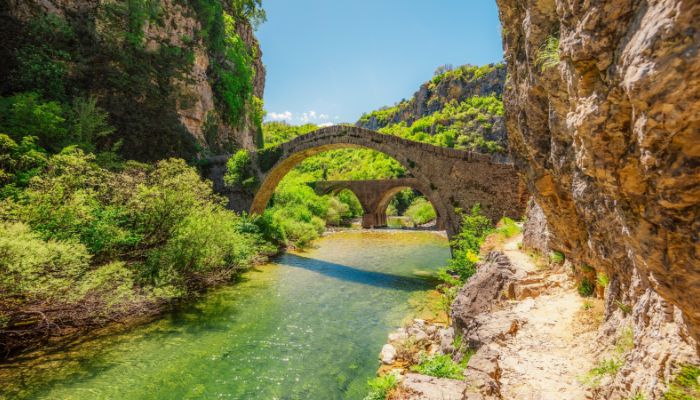
Dazzling and out-of-this-world in all the right ways, northern Greece’s Pindus Mountains is among Greece’s most stunning natural sights. It boasts the Guinness Book of World Records’ deepest gorge in the world, Vikos Gorge, as well as the enchanting, crystal clear waters of Dragon Lake. Legend has it that two enormous dragons resided in these mountains. The dragons fought, and as a part of this argument, they threw enormous boulders down to the valley and formed these lakes.
Wistman's Wood, Devon, England, UK
Filled with old, stunted oak trees, many clad in mossy growths on weathered, rocky outcrops and boulders, Wistman’s Wood is surely one of the UK’s most other-worldly destinations. The high-lying wood seems ripped from the pages of a Tolkien book; it is estimated by experts that it has been in existence since some 12,000 years ago, after the most recent ice age. Despite this – or perhaps because of it – something of a mystical rep has been earned by the wood.
Apparently, not only was the area used for ancient druid rituals, but it's also believed to be the territory of the hell hounds who are out for innocent travellers out alone! This is because it's situated alongside the Lych Way or “Way of the Dead,” an old track that would have been the path to carry coffins up to the nextdoor churchyard.
The Verdict: Real Places, Unreal Stories
At the end of the day, Europe is packed with spots where history and ghost stories completely tangle up. Even though we have the scientific breakdowns for glowing caves or weirdly shaped rocks now, the local legends are what make these places worth talking about. The real magic isn't just how they look—it's the eerie backstory that stays with you.
FAQs
1. Can you actually visit these spots safely?
Yeah, they are all normal tourist stops and totally safe. Just follow the local rules when you get there. For example, you can take all the photos you want of Germany’s Devil’s Bridge, but walking across it is banned so it doesn't collapse.
2. Which ones are debunked by science?
A couple of them have simple explanations, even if the locals blamed monsters first:
- The Blue Grotto: That glowing blue water is just sunlight passing through a hidden underwater hole under the cave mouth.
- Fairy Glen & Giant's Causeway: No magic or giants here. The Glen came from an old landslide, and the Causeway columns formed when volcanic lava cooled down thousands of years ago.
3. Is Bran Castle really Dracula’s home?
Not exactly. Bran Castle gets the "Dracula" label because it looks just like the creepy fortress from the classic book. The real guy who inspired the story, Vlad the Impaler, was only locked up there for a short time. But when the morning mist rolls in, it definitely looks the part.
4. What actually happened to Poland’s Crooked Forest?
Nobody really knows for sure. The two biggest guesses are that a massive snowstorm crushed the trees when they were tiny saplings, or local woodcutters in the 1800s bent them on purpose to grow curved wood for making boats.
5. Why do people link Wistman’s Wood to death?
The mossy, 12,000-year-old trees look spooky enough on their own, but the real reason is a trail called the Lych Way (which literally means "Way of the Dead"). Centuries ago, people had to carry coffins along this path across the moors to get to the closest church cemetery.


.webp)