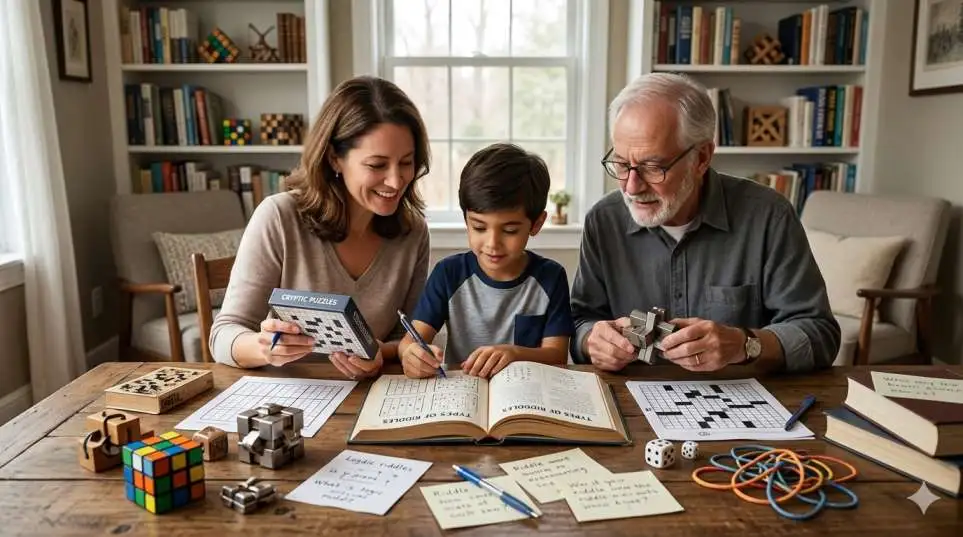
We all love a good brain workout. from our grandmothers telling us small riddles in the village courtyard to the crossword in the morning newspaper, riddles and puzzles have always been a part of our life. They are not just for timepass. They make our mind strong, fast, and clever.
But when we sit down to find a good riddle or puzzle, we get confused. There are so many. Some are word games. Some are number games. Some make you think sideways. That is why today, we will look at the main types of riddles and puzzles in the simplest way. No tough words. No English-speaking-country jargon. Just pure desi understanding.
By the end of this article, you will know the different types of riddles, see types of puzzles with examples, understand the main categories of riddles and puzzles, and even learn about the kinds of brain teasers and riddles that your kids and friends will love. You will also understand logic puzzles and riddles types very clearly. Let us start.
What Exactly Are Riddles and Puzzles? A Simple Definition
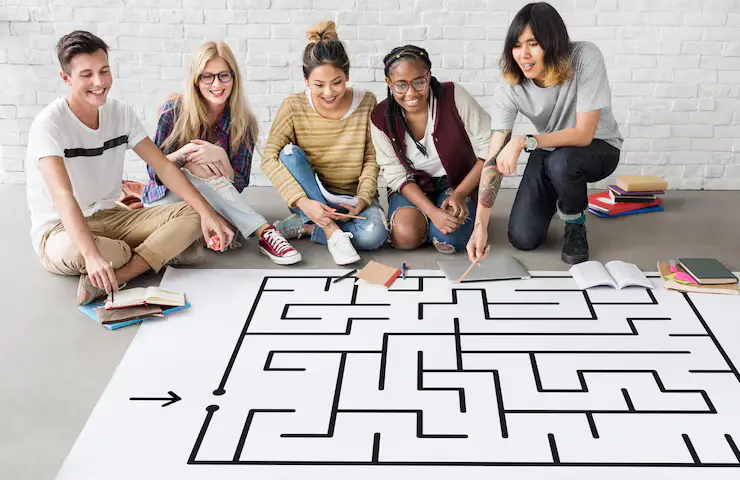
Before we go deep, let us be very clear. A riddle is a question or a statement that has a hidden meaning. You have to find that meaning. For example, "I have a face but no eyes, hands but no arms. What am I?" Answer is a clock.
A puzzle is a bit wider. It is any game or problem that tests your knowledge or patience. It could be a picture, a number pattern, or a wooden block you have to arrange. So, when we talk about types of riddles and puzzles, we are talking about different ways to challenge the human brain. Some make you laugh. Some make you scratch your head. Some make you feel like a detective.
You may also read :- Amusing Brain Teasers with Answers
Understanding the Two Main Types: Riddles First, Then Puzzles
To keep things very clean, we will first look at all the different types of riddles. After that, we will look at the major types of puzzles with examples. This way, your mind will not get mixed up.
Part One: Types of Riddles
Riddles are very old. In our stories, kings used to ask riddles to test the wisdom of ministers. Even in the Vikram-Betaal stories, Betaal asks a riddle before Vikram can catch him. So, riddles have a special place. Here are the main categories of riddles and puzzles under the riddle side.
1. Enigma Riddles
Enigma is a fancy word, but meaning is simple. These riddles use deep thinking and often talk about feelings or big ideas. They do not have a simple one-line answer. You have to think about the meaning of life or nature.
Example: "I am always hungry, I must always be fed. The finger I touch, will soon turn red. What am I?" Answer is fire.
Another example: "I have no voice but I tell stories to all. I have no legs but I travel far. What am I?" Answer is a book.
Enigma riddles are the oldest form. They feel like a small poem. In our villages, old women still tell such riddles about the moon, the rain, and the crops.
2. Clever or Lateral Thinking Riddles
These are very popular today. In a lateral thinking riddle, the answer is not straight. You have to think from the side. You have to break the normal pattern of your brain.
Example: "A man lives on the tenth floor of a building. Every day he takes the lift to the ground floor to go to work. But when he returns, he takes the lift only to the seventh floor and then walks up three floors. Why?"
Normal brain will think the lift is broken. But the clever answer is: The man is very short. He can only reach the button for the seventh floor. He cannot reach the button for the tenth floor. So he walks up.
This is a classic kind of brain teasers and riddles that makes you feel stupid after you hear the answer. But that is the fun.
3. Word Riddles
These riddles play with words. They use double meaning. In English, many words sound same but mean different. In Hindi also, we have such riddles.
Example: "What has a head, a tail, but no body?" Answer is a coin. Here, head and tail are two sides of a coin, not body parts.
Another example: "What has many keys but cannot open a single lock?" Answer is a piano. Keys here mean musical keys, not lock keys.
Word riddles are very good for children. They learn that one word can mean two things. This helps in their language growth.
4. Rhyming Riddles
We love rhyming. Our poems, our bhajans, even our ads on TV have rhyme. Rhyming riddles are easy to remember because they have a beat.
Example:
"I have a little house, no door and no wall,
I live in water, but never feel a fall.
What am I?" Answer is a fish. (Fish lives in water and has no door or wall of a house, but it is a funny rhyme).
Another example: "I fly without wings, I cry without eyes. Whenever I go, darkness flies." Answer is a cloud. It rains (cries) and covers the sun (darkness flies).
Rhyming riddles are a big part of our categories of riddles and puzzles because they are also used in folk songs.
5. Math or Number Riddles
Example: "I am an odd number. Take away one letter from my name and I become even. What number am I?" Answer is seven. Take away the letter 's' from seven, you get 'even'. This is a word and number mix.
Another example: "If two hens lay two eggs in two minutes, how many eggs will four hens lay in four minutes?" Many people say four. But the answer is eight. Because each hen lays one egg in two minutes. So in four minutes, one hen lays two eggs. Four hens lay eight eggs.
Part Two: Types of Puzzles
Now we move to puzzles. Puzzles are more structured. They have a clear start and end. You have to follow rules. Here are the main types of puzzles with examples.
1. Logic Puzzles
Logic puzzles are the king of all puzzles. They give you small pieces of information, and you have to join them to find the answer. This is exactly what we call logic puzzles and riddles types in one box.
Example: Five friends are sitting in a row. Each likes a different color. One likes red, one likes blue, one likes green, one likes yellow, one likes black. You are given clues like "The person who likes red is sitting next to the person who likes blue" and "The person who likes green is at one end". You have to figure out who sits where.
2. Jigsaw Puzzles
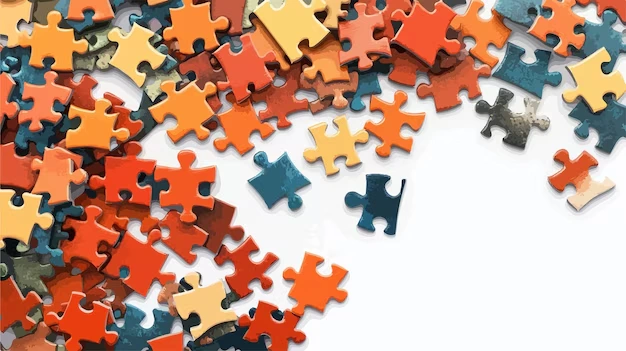
You have seen these. A big picture is cut into many small pieces of different shapes. You have to put them together. This is a physical puzzle. But now we also have jigsaw puzzles on mobile apps.
The beauty of jigsaw is patience. You look at colors, edges, and patterns. You try one piece here, one piece there. Slowly, the full picture comes out. This is very good for old people to keep their mind busy. Also good for small kids to learn shapes.
3. Crossword Puzzles
Everyone who reads a newspaper knows crossword. It is a grid of white and black boxes. You have to fill words across and down based on small clues.
For example, clue: "A big animal with a trunk (5 letters)". Answer is "ELEPHANT" but wait, 5 letters? No, elephant is 8 letters. So correct answer for 5 letters could be "HIPPO" or "RHINO". But rhino does not have trunk. So maybe the clue is different. You see? You have to match the letter count.
Crossword improves your vocabulary and memory. It is one of the most loved types of riddles and puzzles for educated people.
4. Sudoku
Sudoku is a number puzzle. It looks like a big square of 9x9 boxes. Inside, there are 9 smaller squares of 3x3 boxes. You have to fill numbers 1 to 9 in every row, every column, and every small square without repeating any number.
No math is needed. No addition or subtraction. Only logic. Where will this number go? If this row already has a 5, then I cannot put another 5. It is pure placement logic. Sudoku is very popular in trains and waiting rooms because you can play it on paper.
5. Mechanical Puzzles
These are physical puzzles you hold in your hand. The best example is the Rubik’s cube. A cube with many small colored squares. You twist and turn to make each side one color.
Another example is the ring puzzle. Two iron rings are locked together. You have to separate them without force. Or a wooden knot that you have to open.
Mechanical puzzles are very satisfying because you use your fingers and brain together. In villages, carpenters sometimes make small wooden puzzles for children.
6. Picture Puzzles or Spot the Difference
You see two pictures that look almost same. But there are small differences. One picture has an extra tree. One picture has a bird missing. You have to find all differences.
This is a very gentle kind of brain teasers and riddles. Small kids love it. Even old people with weak eyesight can enjoy it if the pictures are big.
7. Rebus Puzzles
Rebus is a puzzle where you use pictures and letters to make a word or a famous phrase.
For example, the word "JOB" written very very small. The answer is "Small job" or "Little job". Another example: The letter "M" and then the word "BOLT". Read together: "M BOLT". The answer is "Thunderbolt" because M sounds like "thunder" in some word games.
Rebus puzzles are very common in WhatsApp forwards. Your uncle sends you a picture of emojis and says, "Guess the movie name". That is a rebus puzzle.
How to Choose the Right Puzzle or Riddle for Different People
For small children below 7 years: Use picture puzzles, spot the difference, and very simple word riddles like "What is black and white and read all over?" Answer is newspaper. Keep it fun, not frustrating.
For school children between 8 to 14 years: Give them logic puzzles, number riddles, and sudoku. This helps in their studies. Also rhyming riddles are good because they can share with friends.
For young adults and job exam aspirants: Focus on logic puzzles and riddles types that appear in exams. Also crosswords for English improvement.
For old people at home: Jigsaw puzzles, mechanical puzzles like simple ring puzzles, and very easy enigma riddles. This keeps their mind active and also keeps their hands moving.
For family time in the evening: Mix everything. One round of word riddles. One small sudoku together. One lateral thinking riddle. This creates bonding.
Why Knowing the Different Types of Riddles and Puzzles is Useful
When you know the different types of riddles, you never get bored. If you are feeling tired of words, you pick a number riddle. If you are tired of numbers, you pick a picture puzzle. If you are alone, you pick a logic puzzle. If you are with friends, you pick a clever riddle to make them laugh.
Also, when you know the categories of riddles and puzzles, you can find them easily online. You search "math riddles for kids" instead of just "riddles". You get exactly what you want.
In our schools, we do not teach puzzles seriously. But the best schools in the world use puzzles to train thinking. You can do this at home. Just 15 minutes of a good puzzle every day. In one month, you will see your mind is sharper. You will remember more. You will solve small life problems faster.
A Small Test for You
Now that you have read the whole article, let me give you one riddle from each category. Try to solve.
-
Enigma riddle: I have rivers but no water. I have forests but no trees. I have cities but no people. What am I? (Answer: A map)
-
Lateral thinking riddle: A woman has two coins that add up to three rupees. One of them is not a one rupee coin. How is this possible? (Answer: One coin is a two rupee coin, and the other is a one rupee coin. The statement says "one of them is not a one rupee coin" – that is true. The two rupee coin is not one rupee. The other coin is one rupee.)
-
Word riddle: What has a neck but no head? (Answer: A bottle)
-
Logic puzzle: Three men are standing in a line. One always tells truth. One always lies. One sometimes lies sometimes tells truth. You can ask one question to one man. How will you find the truth teller? (This is a very famous hard puzzle. I leave it for you to search.)
See? Your brain is already working.
Final Words
Do not think riddles and puzzles are just for children or just for exams. They are for every human being. They keep your brain young. They keep your curiosity alive. In this age of reels and shorts, our attention span is becoming very small. A good riddle forces you to sit for two minutes and think deeply. That is a blessing.
So from today, keep one puzzle book on your table. Or download one good app. Or simply open a newspaper and solve the crossword. Teach one new riddle to your child every morning. Make it a family habit.
The types of riddles and puzzles we saw today – enigma, lateral thinking, word, rhyming, number, logic, jigsaw, crossword, sudoku, mechanical, picture, rebus – all of them are your friends. They do not judge you. They only make you better.
Now go and share this article with your cousin who always says “I am bored”. Give him a riddle. Watch his face light up. That is the real reward.



.webp)