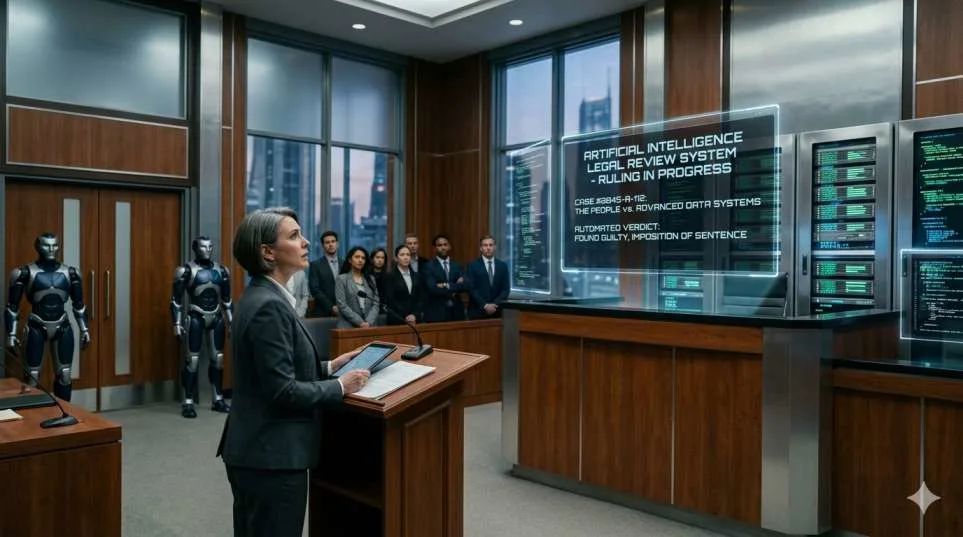
The idea of a robot judge or an algorithm writing our laws used to be something we only saw in movies. However, technology is moving very fast. Today, we use Artificial Intelligence (AI) to help us drive cars, translate languages, and even pick the music we like. It is natural to ask: What happens if AI takes over the legal system?
This is a big question that touches every part of our lives. Laws are the rules that keep our society safe and fair. If we change who—or what—makes those rules, the world will change in ways we are only just beginning to understand.
Speeding Up the Hall of Justice
One of the biggest problems with the legal system today is that it is very slow. In many countries, a simple court case can take years to finish. This happens because humans can only read so fast and work so many hours a day.
Quick Paperwork and Research
Lawyers spend thousands of hours reading old cases and looking for facts. AI can do this in seconds. An AI system can read every law ever written and find the exact page a lawyer needs instantly.
- Faster results: People would not have to wait years for a trial.
- Lower costs: If lawyers spend less time searching, legal help might become cheaper for regular people.
Solving Small Problems Automatically
For small issues, like a parking ticket or a minor disagreement over a contract, AI could provide an instant decision. Instead of going to a building and waiting for a judge, you might use an app. You put in your evidence, the other person does the same, and the AI gives a fair answer based on the law.
You may also read :- What Happens If AI Takes Over? Global Impact, Risks and Human Future
What if AI Writes All Our Laws?
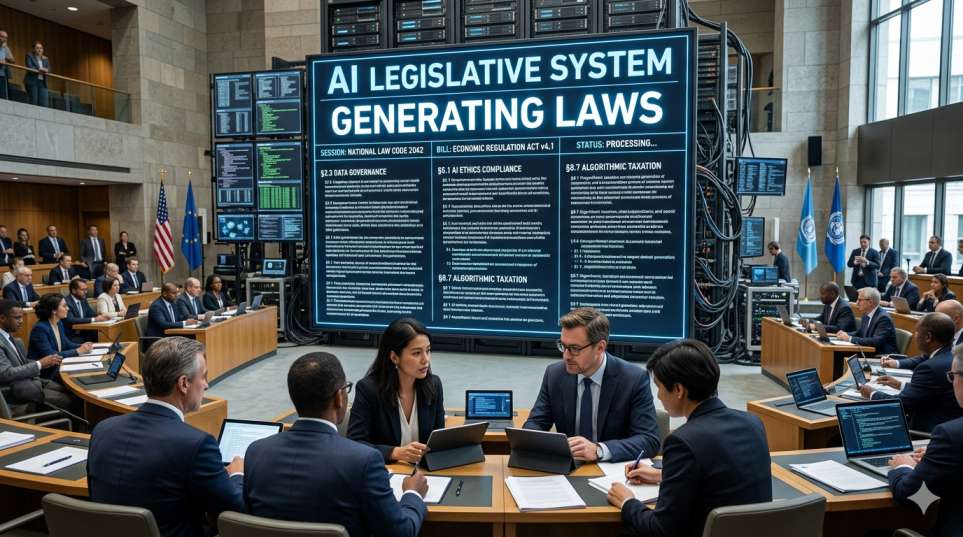
The second part of this shift is even more dramatic: What if AI writes all our laws? Right now, human politicians write laws. They debate, they argue, and they eventually vote. But humans are not perfect. We have feelings, we get tired, and sometimes we make rules that are confusing or benefit only a few people.
Laws Without Mistakes
Human laws often have "loopholes." These are small mistakes in the wording that allow people to break the spirit of the law without getting in trouble. AI is very good at logic. If an AI wrote a law, it would be mathematically perfect. There would be no confusion about what the law means.
Real-Time Updates
Our world changes fast, but our laws change slowly. For example, it took a long time for laws to catch up with the internet. An AI system could monitor the world and suggest new laws the moment a new problem appears. It could look at data from millions of sources to see what rules would make people safest.
The Goal of Total Fairness
One of the strongest arguments for using AI in law is the hope for total fairness. Humans have "bias." This means our personal experiences, where we grew up, or how we feel that day can change how we treat others.
- No Bad Days: A human judge might be crankier after a long day or before lunch. An AI does not get hungry or tired. It treats the first person of the day exactly the same as the last person.
- Data-Driven Decisions: AI looks at facts and numbers. It does not care about what someone looks like or how much money they have. In theory, this could lead to a system where everyone is truly equal under the law.
The Hidden Risks of an AI Legal System
While the benefits sound great, there are serious risks. If we let machines take over, we might lose things that are very important to being human.
The Problem of "Black Box" Logic
When a human judge makes a decision, they explain why. They write down their thoughts so you can understand the logic. Some AI systems are so complex that even the people who built them do not know exactly how they reached a conclusion. This is called a "black box." If an AI sends someone to jail but cannot explain why in a way humans understand, is that justice?
Bias in the Data
AI learns from the past. If the past legal system was unfair to certain groups of people, the AI will learn those unfair patterns. It might think those patterns are "rules" to follow. Instead of fixing bias, the AI could make the bias permanent because it thinks it is just following the data.
The Loss of Mercy
Laws are not just about logic; they are about people. Sometimes, a person breaks a law for a very good reason—perhaps to save a life or because they were in a desperate situation. A human judge can show mercy. They can look into someone's eyes and understand their heart. A machine only sees "True" or "False." An AI legal system might be very "fair" but very cold and cruel.
How This Would Change the Role of Lawyers

If AI takes over, the job of a lawyer will change forever. They will no longer be "researchers" who look for information. Instead, they might become "AI Managers."
Their job would be to make sure the AI is looking at the right data. They would act as a bridge between the cold logic of the machine and the emotions of the human client. Lawyers would focus more on ethics and less on paperwork.
The Question of Responsibility
If a human judge makes a huge mistake, they can be removed from their job. But who is responsible if an AI makes a mistake?
- Is it the computer programmer?
- Is it the company that sold the software?
- Is it the government?
Without a clear person to blame, victims of a bad legal decision might find it impossible to get justice. We would need entirely new laws just to govern the AI that is governing us.
A Hybrid Future: Humans and AI Together
Most experts believe we should not let AI take over completely. Instead, we should use a "hybrid" system. In this world, AI does the heavy lifting—the reading, the data analysis, and the organization—but a human makes the final choice.
This keeps the speed and accuracy of the machine but keeps the heart and soul of the human. It ensures that every person who stands before a court is seen as a person, not just a number in a database.
Final Thoughts
The legal system is the foundation of our civilization. Moving toward an AI-run system could make the world faster, cheaper, and more organized. It could help us write laws that actually work and solve problems before they start.
However, we must be very careful. Law is more than just math. It is about values, ethics, and the way we treat each other. As we build more powerful tools, we must make sure those tools serve us, rather than us serving them.
What happens if AI takes over the legal system? The answer depends on how much we value the "human touch" in our pursuit of justice. We want a system that is smart, but we also need a system that is kind.
Human Judges vs. AI Judges
| Feature | Human Judges | AI Judges |
| Speed | Slow (Months/Years) | Instant (Seconds) |
| Consistency | Can vary by mood/bias | Always follows the same code |
| Empathy | Can feel mercy and pity | Follows strict logic only |
| Reasoning | Easy to explain | Can be hard to understand |
| Cost | Very high | Potentially very low |
Frequently Asked Questions
Can an AI go to law school?
Not really. AI doesn't "learn" like a student. It is programmed with data. However, many AI systems have already passed bar exams (the tests lawyers take) with very high scores.
Will lawyers lose their jobs?
Some jobs, like basic legal research, might disappear. But new jobs will be created to manage the technology and handle the emotional parts of the law.
Is this happening now?
Yes. In some places, AI is already used to help judges decide on bail or to help lawyers predict how a case might end. We are already at the beginning of this journey.






.webp)