
You do not need a big budget or a fancy kit to create an escape room your kids will talk about for weeks. All you really need is a story, a few puzzles, and a little bit of planning. The best part is that the whole thing can be built with paper, string, and items you already have around the house.
This guide walks you through every step. You will learn how to pick a theme, choose the right puzzles for your child's age, hide clues in clever ways, and run the game without a hitch. By the end, you will have everything you need to turn a rainy afternoon or a birthday party into a real adventure.
Start With a Simple Story and a Clear Goal
Every good escape room has a reason to exist. Kids need to know why they are solving puzzles. The story does not need to be complicated. A single sentence is often enough. For example, "You are space cadets who must fix the ship's power core before the oxygen runs out in thirty minutes" . That one line gives players a role, a task, and DIY escape room puzzles for kids.
Pick a theme your child already loves. A few themes that work well for home games include a museum heist, a pirate treasure hunt, a space station rescue, a detective agency mystery, or a wizard school potion emergency . Once you have the theme, name every clue and puzzle to match it. A simple number code becomes a "secret agent transmission" in a spy game or a "star chart" in a space adventure. This small touch makes the whole experience feel real .
The story also helps you decide where to hide things. If the theme is a pirate ship, the final treasure might be hidden under a blanket "sail" or inside a cardboard "chest." The theme gives every step a purpose .
Read Also: Easy Riddles for Kids: Funny Brain Teasers With Answers
Pick the Right Space and Time Limit for Your Child's Age
You do not need a large room. A living room, a bedroom, or even a corner of a classroom works fine as long as you can hide clues safely . Move any breakable items out of the way before the game starts.
The time limit matters more than the space. Younger children lose focus if the game runs too long. A good rule of thumb is to keep the whole game under thirty minutes for a first attempt . For ages five to seven, aim for fifteen to twenty minutes with very simple clues. Ages eight to ten can handle twenty to thirty minutes. Ages ten to thirteen can enjoy a game that lasts thirty to forty-five minutes with more steps .
If you are hosting a party, you can run one big game with four to eight kids at once. Or you can split into teams and give each team the same puzzles in different corners of the room. Teams of two or three often work best because every child gets a chance to participate .
Build Puzzles That Fit Your Child's Age and Skills
The heart of any escape room is the puzzles. The goal is to make kids think without making them frustrated. A good puzzle should feel like a small victory when it is solved. Mix different types of puzzles so that children who are good at words, numbers, and searching all get a moment to shine .
Code and Cipher Puzzles
These are the most common escape room puzzles, and they are easy to make at home. A number-to-letter code is simple: write A equals 1, B equals 2, and so on. Then write a message like "8-9-4-5 21-14-4-5-18 20-8-5 18-21-7" which spells "hide under the rug" . This works well for ages seven and up and takes about five minutes to solve.
A pigpen cipher uses shapes instead of letters. Give kids a key where each letter is drawn as a different shape, and have them decode a word that tells them where to look next. This is a good challenge for ages eight and up .
A mirror message is another simple option. Write the clue backwards and leave a small mirror nearby. Younger kids can often read it right to left without the mirror, which makes this a good warm-up puzzle for ages six and up .
Hidden Object and Scavenger Hunt Puzzles
These puzzles get kids moving. Hide three to five objects around the room. Each object has part of a clue written on it. Once kids collect all the pieces, they can read the full message . You can hide a code behind a framed picture, under a chair, inside a book, or taped to the underside of a table. Just make sure nothing is sharp or unstable.
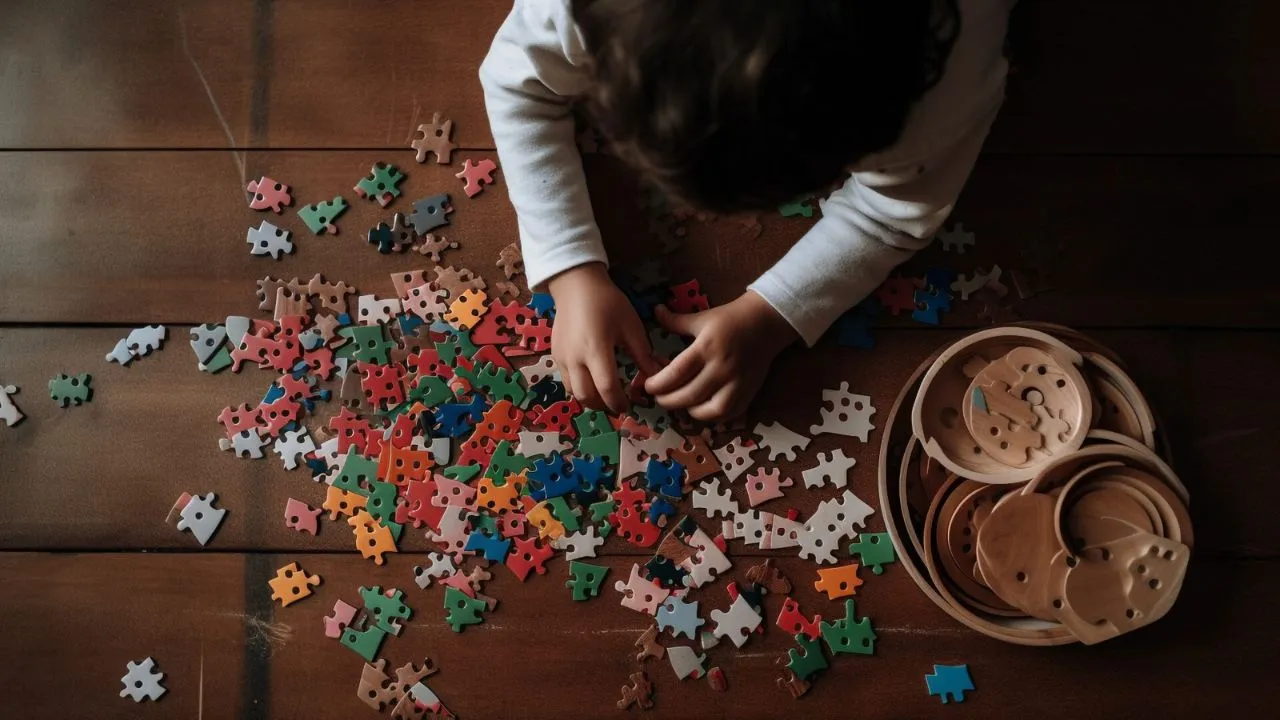
A jigsaw clue is another favorite. Write the next clue on a sheet of paper, cut it into eight to twelve pieces, and hide the pieces around the room. Kids find all the pieces and put the message together. This works well for a wide range of ages because it is hands-on and diy escape room puzzles for kids.
Logic and Number Puzzles
These puzzles ask kids to think carefully. A simple math path uses a short worksheet of math facts where only the right answers connect into a path. The path ends on a number, which becomes the next code . A trivia lock uses three questions with number answers to create a three-digit code. For example: "How many legs does a spider have? How many days in a week? How many sides on a triangle?" gives 8-7-3 .
A riddle that names a hiding spot is a classic for a reason. "I have keys but open no locks. I have space but no room." The answer is a keyboard, which tells kids to look under the keyboard . Riddles work best when the answer is a physical object in the room.
Physical and Hands-On Puzzles
A laser maze uses string or yarn stretched across a hallway or between furniture. Kids have to climb through without touching the strings to reach the next clue . This is a great energy-burner and works well for almost any age as long as you set the strings at a safe height.
Invisible ink is another option that feels like real spy work. Write a message with lemon juice and let it dry. Kids reveal it by gently warming the paper with a lamp or a warm iron, with adult supervision . A white crayon on white paper also works: kids color over the paper with a marker or watercolor paint to reveal the hidden message .
You May Also Like: How To Solve Sudoku Puzzles? Everything We Need To Know
Chain the Puzzles So Each Clue Leads to the Next
An escape room is not a pile of separate puzzles. It is a chain. Each solved puzzle should lead directly to the next clue or to a piece of the final code . This is what makes the game feel like a journey instead of a worksheet.
Plan the order before you build anything. Write down the first clue, where it leads, what kids find there, and how that leads to the next step. A simple flow might look like this: kids solve a number code that tells them to look under the couch. Under the couch is a jigsaw puzzle. When they put it together, the picture shows a bookshelf. On the bookshelf is a locked box with a three-digit combination. Inside the box is the final prize.
Keep the number of steps small for younger kids. Two or three puzzles are often enough for ages five to seven. Older kids can handle four or five steps . The goal is to keep the energy high and the frustration low.
Set Up the Room So the Game Runs Smoothly
Preparation is the difference between a fun game and a chaotic one. Give yourself about twenty to thirty minutes to set up before the kids arrive . Print or write out all the clues first. Then hide them in the order you planned. Double-check that every clue is in the right place and that the final prize is ready.
Have a welcome letter waiting at the starting point. This letter sets the story, explains the goal, and gives the first clue . It gives kids a clear place to begin and makes the game feel official.
Keep a set of hint cards with you. These are small slips of paper with gentle nudges, not full answers. For example, a hint might say "Look near something that rhymes with 'chair'" instead of "Look under the chair." Hint cards keep the game moving if a team gets stuck without giving away the solution .
Test the game before the kids play. If possible, run through the puzzles yourself or have another adult try them. Things that seem obvious to you may be confusing to a child. Testing helps you catch unclear clues or puzzles that are too hard or too easy .
Run the Game With Energy and Patience
When the kids arrive, read the welcome letter out loud with a dramatic voice. Set the timer where everyone can see it. Then let them go .
Your job during the game is to watch and guide, not to solve. If a team is stuck, offer a hint card after a minute or two. If they are moving well, stay quiet and let them work. The best moment in any escape room is when kids figure something out on their own. That feeling of "we did it" is the whole point .
If you are running the game for a party, have a small prize ready for the final box. It does not need to be expensive. A snack, a small toy, or even a "You Did It" certificate works well . The prize is just a celebration of the real reward, which is the fun of solving the puzzles together.
A Final Word on Making It Your Own
The best DIY escape room is the one that fits your child. If your kid loves animals, build a rescue mission. If your kid loves mystery stories, build a detective case. If your kid loves building things, make the puzzles more hands-on with blocks or cut-out shapes .
You do not need to copy anyone else's plan. Use the ideas in this guide as a starting point, then change the story, the hiding spots, and the puzzles to match your space and your child. The more personal the game feels, the more memorable it will be.
And do not worry if something goes wrong. A clue might be too hard. A hiding spot might be too obvious. That is fine. You can adjust for the next game. The important thing is that you tried, and that your kids got to experience the thrill of solving a mystery together. That is something they will remember long after the timer runs out.





.webp)